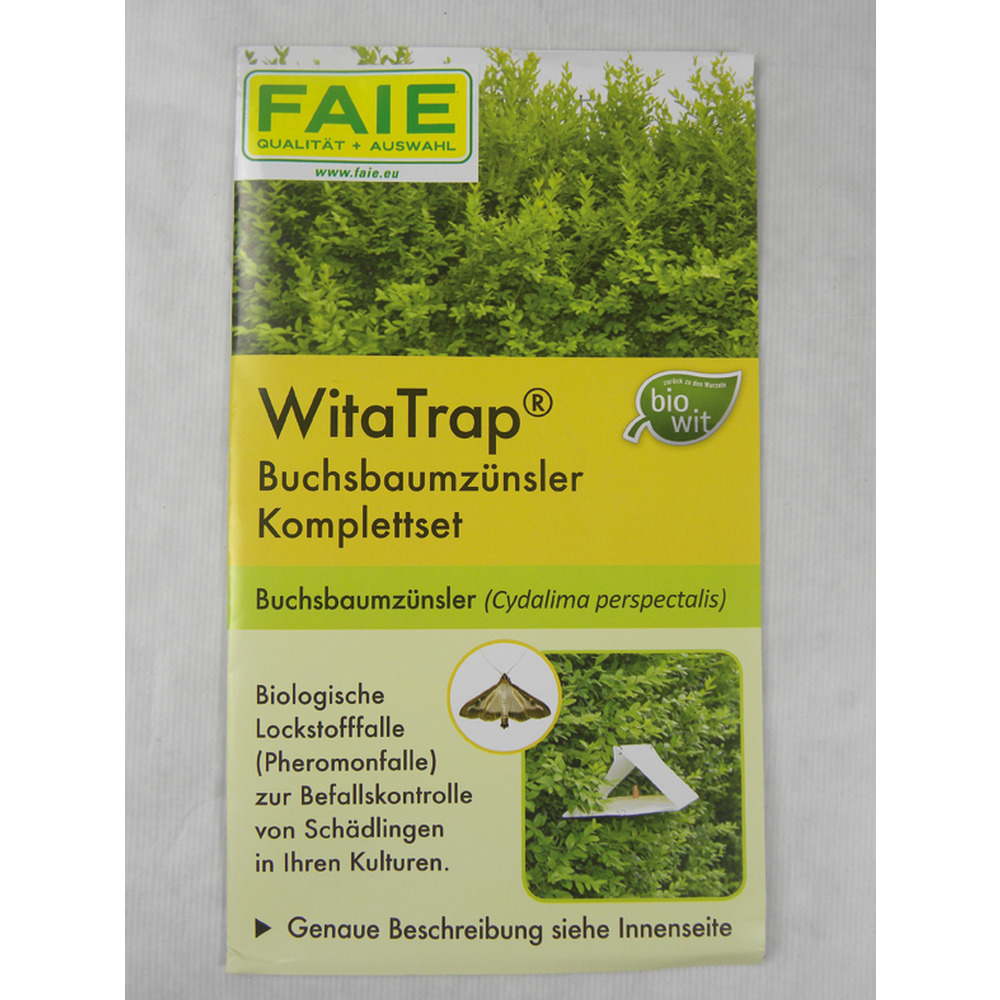
Occurrence: various boxwood species Main symptoms: eaten leaves, light beige in color light green feces crumbs in the web and under the plant in severe infestation webs clearly visible Biology: The larva spins itself between the leaves and hibernates. In spring, when temperatures rise to over 7C for a longer period of time, the caterpillars start feeding again. They usually go through 6 larval stages during their development into pupae. The females, which live for around 8 days, lay their eggs on the underside of the leaves. Under favorable climatic conditions, the development of a second and third generation per year is possible. Egg laying: female lays approx. 100-150 eggs Caterpillar stage (damage stage): approx. 10 weeks at 15C for approx. 3 weeks 25-30C Lifespan of the butterflies: approx. 8-9 days Flight time of the first generation: mid-March to early April (at dusk) Flight time of the second &~ third generation: until OctoberApplication: Assemble the trap and attach it with the included wire depending on the area of use. (The exact assembly instructions and the area of use are described in detail for each pheromone trap.) In order not to lure the pest directly into the crops to be protected, the trap should be hung in another nearby tree, for example. If this is not possible, the trap can be attached to a stake. Hang the trap between the main wind direction and the tree, at eye level. The trap entrances must not be blocked by branches and leaves. Each trap should be checked at regular intervals of 2-3 days. Whenever the trap is checked, the glue base must be cleaned of adhering insects using an auxiliary instrument (e.g. twig, wooden spatula) if necessary so that the full glue surface is retained. If it is heavily soiled, replace the glue base or re-glue it with Soveurode special glue (spray glue). Replace the attractant stubble and, if necessary, the glue base after 4-8 weeks.The traps must be hung up before the moth begins to fly. A trap set consists of: 1 trap body (WitaTrap Delta Super Trap grp) 2 glue bases (packaged separately) 2 pheromone stubble (packaged separately) Hanging wire for assembly and a precise description.
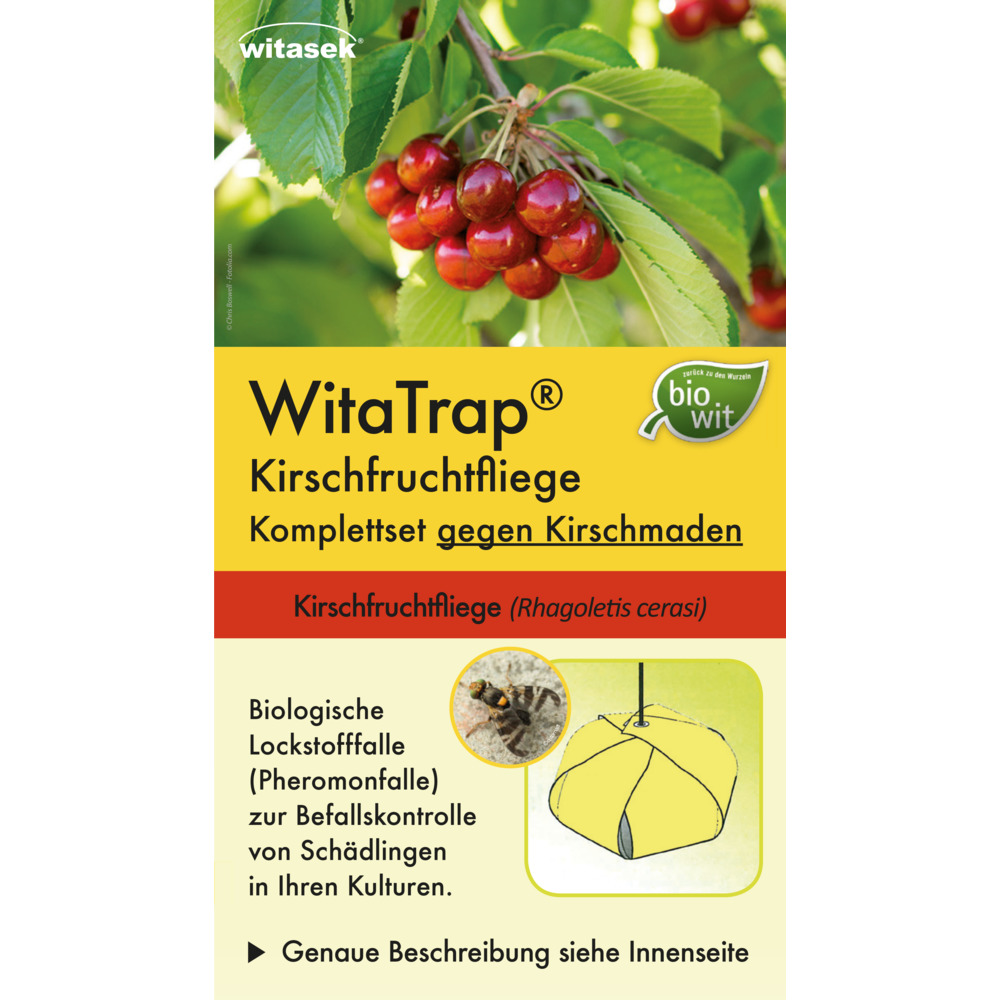
Occurrence: CherryMain symptoms:affected fruits show a brownish discolored area in the stem arearotten, soft flesh around the corewhite , elongated larva Biology:Overwintering as a pupa in the ground. The fly appears from mid-May and lays its eggs individually on the half-ripe, coloring fruits (from green towards yellow). The maggots hatch after 6-12 days and feed on the pulp. After several weeks of feeding, the maggot leaves the fruit and falls to the ground. Medium and late varieties are particularly damaged.Egg laying: Female lays approx. 200 eggsLorva development time: Larvae hatch after 6-12 daysMain flight time: early May to June (fly)Optimal Conditions for flight: 20-21C, below 16C stops egg layingApplication: Assemble the trap and place it around a branch in the upper third of the tree crown. Experience has shown that the ripening process begins earlier on the south side, in the upper third of the crown. The yellow panels should therefore be attached to the outside (sunny) at the beginning of the flight season. The number of panels depends on the size of the tree (2-10 pieces). Keep the glue surface facing outwards free of branches and leaves. Each trap should be checked at regular intervals of 2-3 days. Whenever the trap is checked, the glue surface must be cleaned of adhering insects using an auxiliary instrument (e.g. twig, wooden spatula) if necessary so that the full glue surface is retained. If the yellow board is heavily soiled, replace it or re-glue it with Soveurode special glue (spray glue). Replace the attractant and, if necessary, the entire yellow panel after 4-8 weeks.The traps must be hung up before the butterfly begins to fly.A trap set consists of: 2 trap bodies ( WitaTrap yellow board) pre-glued 2 pheromone stubbles (packaged separately) Sample bag clips for closing the trap and a detailed description.
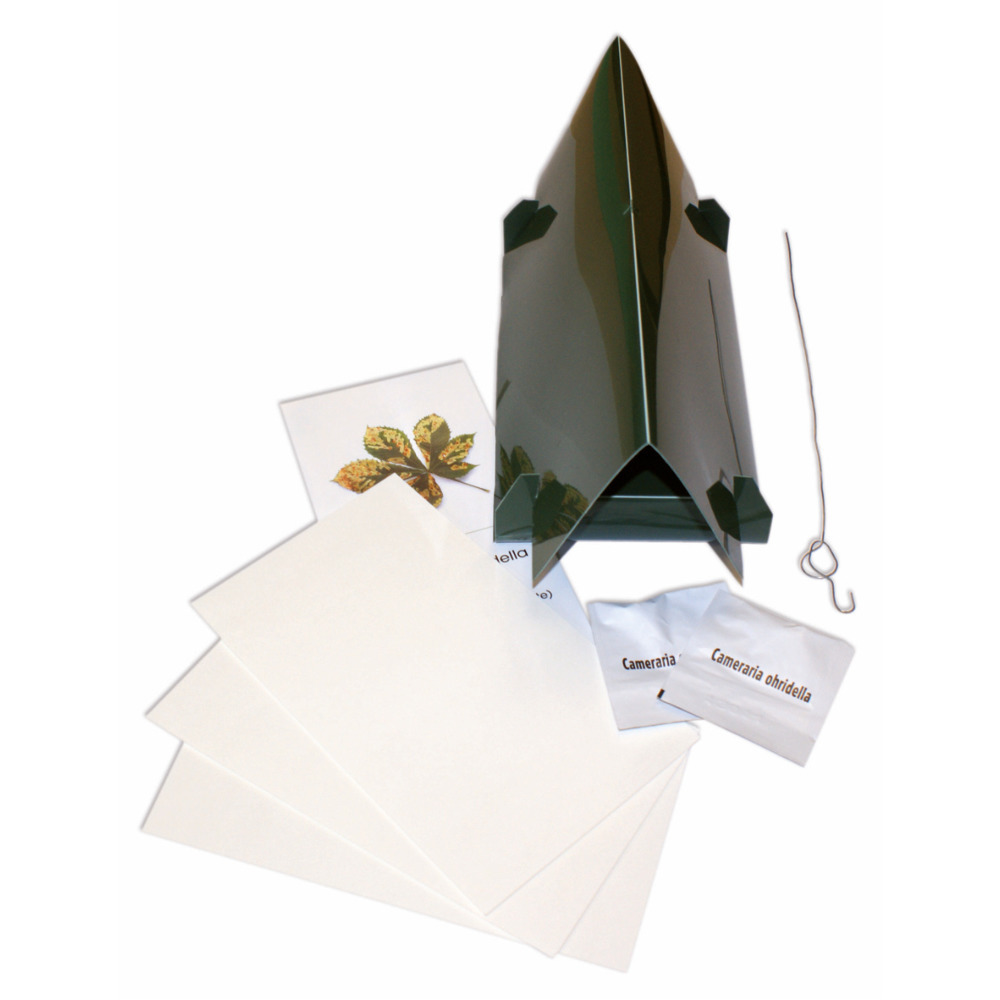
It is now rare to find chestnut trees that are not infested with the chestnut leaf miner. It is already widespread throughout Central Europe. This set is perfect for monitoring the flight behavior of the chestnut leaf miner to ensure targeted and successful control. The pheromone primarily catches the males, who are thus removed from the population development. There is a reduction in egg laying and thus a reduction in moth intensity. Duration of effect 7-8 weeks. Application: Assemble the trap and attach it with the included wire depending on the area of use. (The exact assembly instructions and the area of use are described in detail for each pheromone trap.) In order not to lure the pest directly into the crops to be protected, the trap should be hung in another nearby tree, for example. If this is not possible, the trap can be attached to a stake. Hang the trap between the main wind direction and the tree, at eye level. The trap entrances must not be blocked by branches and leaves. Each trap should be checked at regular intervals of 2-3 days. Whenever the trap is checked, the glue base must be cleaned of adhering insects using an auxiliary instrument (e.g. twig, wooden spatula) if necessary so that the full glue surface is retained. If it is heavily soiled, replace the glue base or re-glue it with Soveurode special glue (spray glue). Replace the attractant stubble and, if necessary, the glue base after 4-8 weeks.The traps must be hung up before the moth begins to fly. A trap set consists of: ~ ~ ~ ~ ~ ~ ~ ~ ~ ~ ~ ~ ~ ~ ~ ~ ~ ~ ~ ~ ~ ~ ~ ~1 trap body (WitaTrap Delta Super trap large) ~2 glue bases (packaged separately) ~ ~ ~ ~ ~ ~ ~ ~ ~ ~ ~ ~ ~ ~ ~ ~ ~ ~ ~2 pheromone stubbles (packaged separately) ~ ~ ~ ~ ~ ~ ~ ~ ~ ~ ~ ~ ~Suspension wire for assembly and ~ ~ ~ ~ ~ ~ ~ ~ ~ ~ ~ ~ ~ ~ ~ ~ ~ ~ ~ ~< br> ~an accurate description. ~ ~ ~ ~ ~ ~ ~ ~ ~ ~ ~ ~ ~ ~ ~
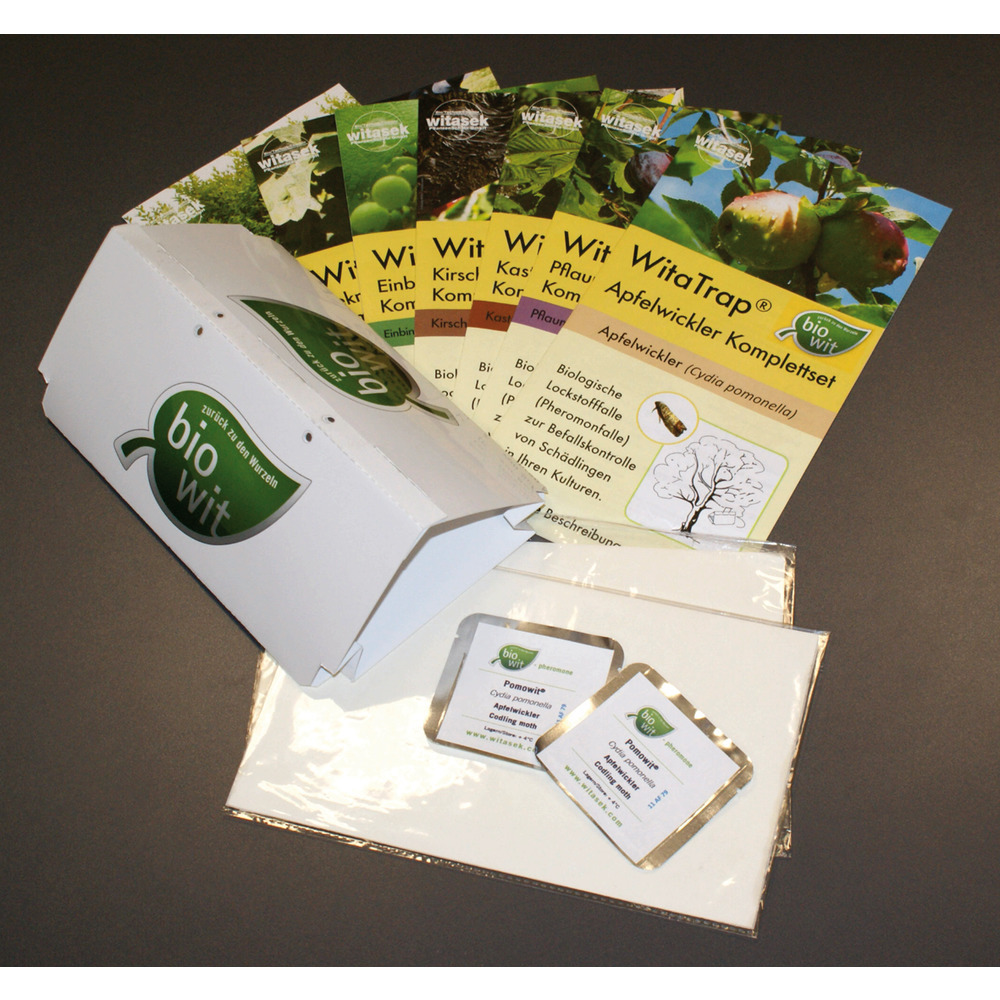
Main symptoms:The larva of the codling moth damages the fruits by drilling.There are crumbs of feces on the borehole.Fruits fall off prematurely.Biology: The larva overwinters in a solid web (cocoon) between bark scales or in the ground! Pupation and hatching in mid-May to mid-June, followed by egg laying on leaves and fruits. The larvae bore into the fruit and feed on the pulp and ovules.Oviposition: Female lays approx. 20-50 eggsDevelopment time from egg to larva: 28 days at 15C6 days at 25CDevelopment period of the larva: approx. 20-30 daysDevelopment period of the pupation: approx. 20-28 daysMain flight time of the first generation: May and June/JulyOptimal conditions for the Flight: Dusk (approx. 20C) below 10C development is interruptedMain flight time of the second generation: Under favorable climatic conditions the development of a second generation is possible, which then flies in July/AugustATTENTION: The 2nd generation causes even more significant damage than the 1st generation!! Application: Assemble the trap and attach it with the included wire depending on the area of use. (The exact assembly instructions and the area of use are described in detail for each pheromone trap.) In order not to lure the pest directly into the crops to be protected, the trap should be hung in another nearby tree, for example. If this is not possible, the trap can be attached to a stake. Hang the trap between the main wind direction and the tree, at eye level. The trap entrances must not be blocked by branches and leaves. Each trap should be checked at regular intervals of 2-3 days. Whenever the trap is checked, the glue base must be cleaned of adhering insects using an auxiliary instrument (e.g. twig, wooden spatula) if necessary so that the full glue surface is retained. If it is heavily soiled, replace the glue base or re-glue it with Soveurode special glue (spray glue). Replace the attractant stubble and, if necessary, the glue base after 4-8 weeks.The traps must be hung up before the moth begins to fly. A trap set consists of: 1 trap body (WitaTrap Delta Super trap large)2 glue bases (packaged separately) 2 pheromone stubble (packaged separately) Hanging wire for assembly and a precise description.
The pheromone primarily catches the males, who are thus removed from the population development. There is a reduction in egg laying and thus a reduction in the intensity of damage.Use only in combination with WitaTrap Delta trap or yellow board. Duration of action: 7 - 8 weeks! Pest: Chestnut leaf miner - Cameraria ohridella Occurrence: Chestnuts, predominantly in the leaves of the white-flowering, common horse chestnutsMain symptoms:The first small light brown spots appear in mid-May (after budding). on the leaves, which then quickly enlarge.Biology:The larva overwinters in the falling leaves. The first generation emerges from the ground at the end of April/beginning of May. The females lay their eggs on the upper side of the leaves when chestnuts are in bloom. The first generation primarily affects the lower crown area. After about 2 weeks, the larvae hatch, bore into the leaf and eat the tissue between the top and bottom. The second generation butterflies fly at the end of June/July. Theoretically there can be up to four generations, but this is often not possible due to premature leaf fall.Oviposition: female lays approx. 100 eggsDevelopment time of the larva: approx. 2 weeksDevelopment time for pupation: approx 2 weeksMain flight time of the generations: end of April to August (theoretically possible until October)
Occurrence: plums, plums and mirabelle plums ~Main symptoms:Drilling of the fruits by the larvaA "rubber drop" is often present at the drill holeFructus around the core housing is destroyedFruit becomes unripe and falls off prematurely Biology: ~The larva hibernates in a cocoon under bark scales, rarely also in the ground. The first butterflies appear in May and lay their eggs individually on the fruits. The hatched larvae bore into the fruits and later leave them to pupate in the trunk.At the end of July, the second generation butterflies appear and deposit their eggs on the already ripening fruits. The resulting larvae bore into the fruit again and cause massive damage to the harvest. They overwinter in a cocoon. ~Egg laying: Females lay approx. 40-60 eggs ~Development time from egg to larva: around 10-14 days ~Main flight season: May and August (usually in the evening hours)Application: ~Assemble the trap and attach it with the included wire depending on the area of use. (The exact assembly instructions and the area of use are described in detail for each pheromone trap.) ~In order not to attract the pest directly to the crops to be protected, the trap should be hung in another nearby tree, for example. If this is not possible, the trap can be attached to a stake. Hang the trap between the main wind direction and the tree, at eye level. The trap entrances must not be blocked by branches and leaves. ~Each trap should be checked at regular intervals of 2-3 days. Whenever the trap is checked, the glue base must be cleaned of adhering insects using an auxiliary instrument (e.g. twig, wooden spatula) if necessary so that the full glue surface is retained. If it is heavily soiled, replace the glue base or re-glue it with Soveurode special glue (spray glue). ~Replace the attractant stubble and, if necessary, the glue base after 4-8 weeks.The traps must be hung up before the butterfly begins to fly. ~A trap set consists of: ~ ~ ~ ~ ~ ~ ~ ~ ~ ~ ~ ~ ~ ~ ~ ~ ~ ~ ~ ~ ~ ~ ~ ~1 trap body (WitaTrap Delta Super trap large) ~2 glue bases (packaged separately) ~ ~ ~ ~ ~ ~ ~ ~ ~ ~ ~ ~ ~ ~ ~ ~ ~ ~ ~2 pheromone stubbles (packaged separately) ~ ~ ~ ~ ~ ~ ~ ~ ~ ~ ~ ~ ~Hanging wire for assembly and a detailed description.
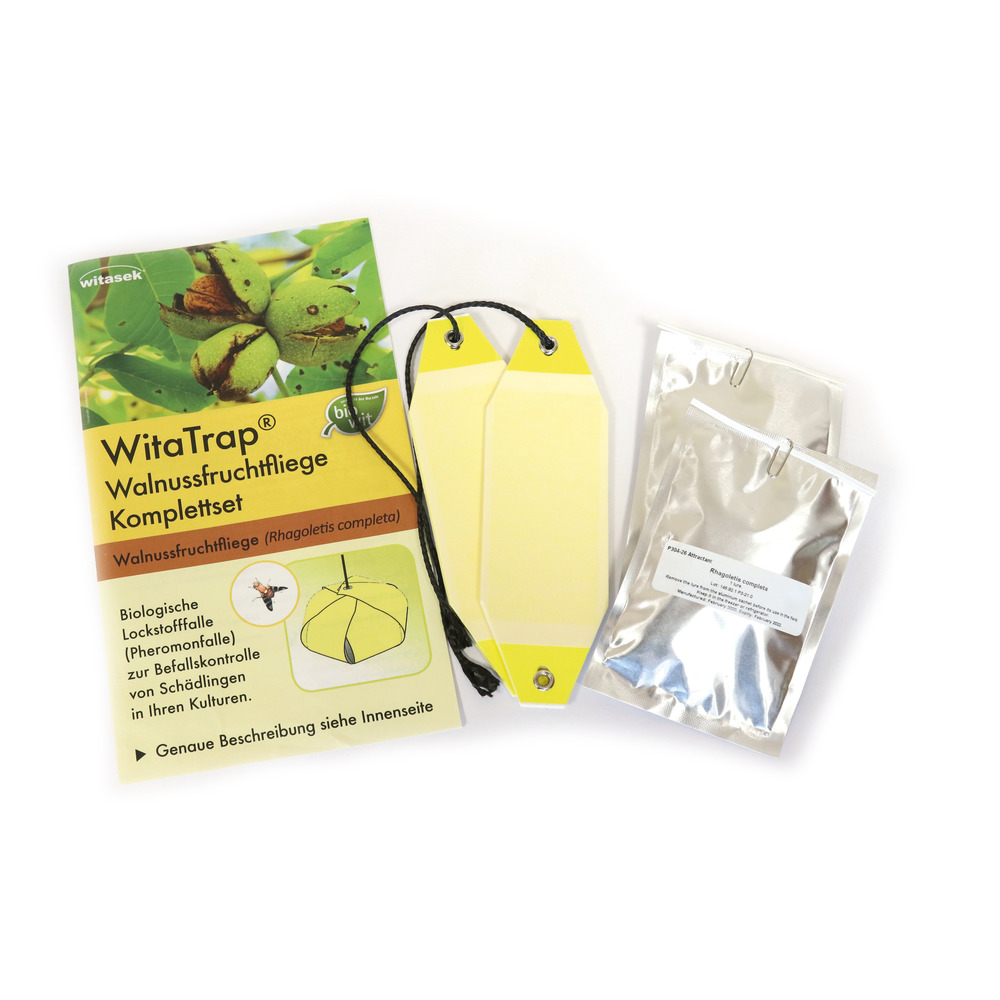
The walnut fruit fly (Rhagoletis completa) is one of the most important animal pests of nuts (Juglans spp.). The adult flies hatch from around the end of June, the main flight time is in the summer months until the end of September. They lay eggs in the green fruit peel. The whitish-yellow larvae (maggots) live gregariously and feed on the pulp, making it soft, black and slimy. After about 3-5 weeks of feeding activity, the larvae fall to the ground to bury themselves in the soil to pupate there. The new generation of flies will only follow next year. Application: ~In order not to lure the pest directly into the crops to be protected, the trap should be hung in another nearby tree, for example.If this is not possible, the trap can be attached to a hammered stake. Hang the trap at eye level between the main wind direction and the tree.The traps must not be blocked by branches and leaves. Each trap should be checked at regular intervals of 2-3 days.If there is a heavy catch, re-glue the surfaces or replace the trap. The attractant remains active for approx. 6-8 weeks and should then be replaced.The traps must be hung up before the start of the flight.Set consists of: 1 Trap body (WitaTrap Delta Super trap large), 2 glue bases, 2 pheromone stubble, suspension wire and description.
€34.95*
€10 voucher.
If you sign up for our newsletter. You will receive €10 for free with your next purchase.
Functional cookies are absolutely necessary for the functionality of the web shop. These cookies assign a unique random ID to your browser so that your unhindered shopping experience can be guaranteed over several page views.
Userlike:
Userlike provides a live chat for site users. The cookie ensures the function of the application over several page views.
Stored data:
Shopware Analytics adds the following information to your browser's local storage until consent is revoked: _swa_anonymousId (a unique identifier of the visitor), _swa_userTraits (user traits of the visitor).
Mollie Payment:
This cookie is used to group all events generated from a unique user session across multiple checkout pages.
Amazon Pay:
The cookie is used for payment transactions via Amazon.
Google Tag Manager debug mode:
Allows to run the Google Tag Manager in debug mode.
IP Targeting and Language Detection:
Saves the detection of the browser language and the assigned country based on the ip address.
IP Targeting and Language Detection:
Saves the detection of the browser language and the assigned country based on the ip address.
IP Targeting and Language Detection:
Saves the detection of the browser language and the assigned country based on the ip address.
IP Targeting and Language Detection:
Saves the detection of the browser language and the assigned country based on the ip address.
IP Targeting and Language Detection:
Saves the detection of the browser language and the assigned country based on the ip address.
IP targeting detected country:
Saves the country recognised on the basis of the IP address so that it can be preselected in forms.
IP targeting detected country:
Saves the country recognised on the basis of the IP address so that it can be preselected in forms.
IP targeting detected country:
Saves the country recognised on the basis of the IP address so that it can be preselected in forms.
IP targeting detected country:
Saves the country recognised on the basis of the IP address so that it can be preselected in forms.
IP targeting detected country:
Saves the country recognised on the basis of the IP address so that it can be preselected in forms.
IP targeting detected country:
Saves the country recognised on the basis of the IP address so that it can be preselected in forms.
IP targeting detected country:
Saves the country recognised on the basis of the IP address so that it can be preselected in forms.
IP targeting detected country:
Saves the country recognised on the basis of the IP address so that it can be preselected in forms.
IP targeting detected country:
Saves the country recognised on the basis of the IP address so that it can be preselected in forms.
IP targeting detected country:
Saves the country recognised on the basis of the IP address so that it can be preselected in forms.
IP targeting detected country:
Saves the country recognised on the basis of the IP address so that it can be preselected in forms.
IP targeting detected country:
Saves the country recognised on the basis of the IP address so that it can be preselected in forms.
IP targeting detected country:
Saves the country recognised on the basis of the IP address so that it can be preselected in forms.
IP targeting detected country:
Saves the country recognised on the basis of the IP address so that it can be preselected in forms.
EAA
Countdown banner:
Saves the open or closed state of the countdown banner.
Countdown banner:
Saves the open or closed state of the countdown banner.
Countdown banner:
Saves the open or closed state of the countdown banner.
xDebug:
xDebug Session
Session:
The session cookie stores your shopping data over several page views and is therefore essential for your personal shopping experience.
CSRF token:
The CSRF token cookie contributes to your security. It strengthens the security of forms against unwanted hacker attacks.
Timezone:
The cookie is used to provide the system with the user's current time zone.
Cookie settings:
The cookie is used to store the cookie settings of the site user over several browser sessions.
Cache handling:
The cookie is used to differentiate the cache for different scenarios and page users.
Information on origin:
The cookie stores the referrer and the first page visited by the user for further use.
Activated cookies:
Saves which cookies have already been accepted by the user for the first time.
CAPTCHA integration
Emarsys / Scarab:
Dieses Cookie wird für Statistiken und Shop Performance Metriken genutzt.
Userlike Messenger:
Required in order to use this website's live chat functionality.
Marketing cookies are used to display advertisements on the website in a targeted and individualized manner across multiple page views and browser sessions.
Google conversion tracking:
The Google Conversion Tracking Cookie is used to track conversions on the website effectively. This information is used by the site operator to target Google AdWords campaigns.
Google AdSense:
The cookie is used by Google AdSense to promote advertising efficiency on the website.
Facebook Pixel:
The cookie is used by Facebook to display personalized advertising offers based on user behavior to users of websites that integrate Facebook services.
Tracking cookies help the shop operator to collect and evaluate information about the behaviour of users on their website.
Matomo:
The cookie is used to track website activity. The information collected is used for site analysis and to generate statistics.
Adcell:
Adcell uses cookies to evaluate the visitor traffic on the website. Furthermore, the origin of orders and the interaction of advertisements can be traced.
Hotjar:
Hotjar cookies are used to analyze website activities of users. The site user is identified by the cookie over several page views and his or her behavior is analyzed.
Hotjar:
Hotjar cookies are used to analyze website activities of users. The site user is identified by the cookie over several page views and his or her behavior is analyzed.
Yandex Metrica:
Yandex Metrica cookies are used for traffic analysis of the website. Statistics on website activity can be created and read.
Google Analytics:
Google Analytics is used for traffic analysis of the website. Thereby statistics about website activities can be created and read out.
Bing Ads:
This cookie is used by Bing to gather anonymous information on how visitors are using the website.
Emarsys:
This cookie is used to display personalised product recommendations in the web shop.
These cookies are used to collect and process information about the use of the website by users, in order to subsequently personalise advertising and/or content in other contexts.
Criteo retargeting:
The cookie is used to enable personalized ads on third party websites based on pages and products viewed.
Criteo retargeting:
The cookie is used to enable personalized ads on third party websites based on pages and products viewed.
Service cookies are used to provide the user with additional offers (e.g. live chats) on the website. Information obtained via these service cookies may also be processed for site analysis.
Tawk:
Tawk provides a live chat for site users. The cookie ensures the function of the application over several page views.
These cookies are used for statistics and shop performance metrics.
Google Analytics
Conversion and usertracking via Google Tag Manager
DooFinder
DooFinder
Wishlist
YouTube video
Youtube / Vimeo:
This cookie is required for playing youtube videos which use cookies.
Allows Google to collect personal data for online advertising and marketing.
Google Advertising
Google Tag Manager
acrisTagManagerApp.acrisTagManagerCookieName
We respect your privacy
This website uses cookies to ensure you get the best experience on our website... More information.